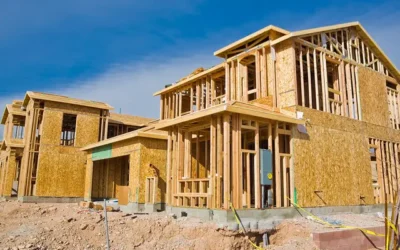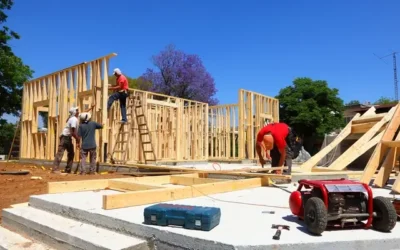
VA Construction Loans 2026: Build a Home with $0 Down
Your approval is based on three pillars; credit, income and assets. A VA construction loan can roll the lot and the build into one closing, but this is not a normal VA purchase file. The VA is not your lender. The overlays are tighter, the documentation is heavier, and builder, budget, and property issues become deal issues fast on construction.
The concept is simple. Getting it approved and built is where this gets harder. The real pressure points are the approval tiers, whether the builder can pass lender review, what property types actually fit the program, and whether the job is truly proposed construction instead of something that already started.
Next step: Check Your VA Loan Eligibility
Program Structure
- One-Time Close: Land and build financed in one closing. No second closing and no second set of loan fees.
- Build term cap: 6, 9, or 12 months. No single construction period can run longer than 12 months without an extension.
- Fixed rates only. No ARMs on this program.
- No manual underwriting. DU only. If it does not come back Approve/Eligible, this program does not work.
Approval Tiers
- Up to $832,750: 620 score, 100% LTV, 55% DTI.
- $832,751 – $1,000,000: 620 gets you 50% DTI. 640 gets you 55%. Both at 100% LTV.
- $1,000,001 – $2,000,000: 660 minimum, 95% LTV, 50% DTI.
- Above $1M: Three compensating factors required. That is not optional on this program.
Property And Builder Rules
- Primary residence only. 2–4 units allowed if you live in one. Future rents do not count for qualifying.
- Eligible builds: Site-built, modular, barndominiums, manufactured homes, and ADUs paired with new primary construction.
- Big disqualifiers: Pre-starts, container homes, attached units, co-ops, condos, mixed-use, and working farms. If permanent structural work already started, this program usually does not work.
- Builder rules are tight. No owner-builder. No DIY. No third-party management. Fixed-price or fixed-cost contracts only.
Appraisal And Draw Process
- Appraisal before closing. Done subject-to plans and specs using the as-completed value.
- Usually no second appraisal. The file typically finishes with a final inspection instead of a brand-new appraisal order.
- Package has to be tight. Builder contract, full plans and specs, site plan, and VA construction forms before the appraisal is ordered.
- Draws go to the builder. Percentage-of-completion or line-item schedule. 10% at closing, 10% at final.
Frequently Asked Questions
Can you use a VA construction loan with zero down?
Does this VA construction program allow manual underwriting?
Can a borrower act as their own builder on this program?
Are 2–4 unit properties allowed on this VA construction program?
Do I make payments during construction?
What credit score do I need for this program?
The Bottom Line Up Front
Your approval is based on three pillars; credit, income and assets. A VA construction loan qualifies the same way any VA loan does — credit, income, assets, and whether the automated underwriting system accepts the file. If you meet the requirements for a standard VA purchase, you are closer to qualifying for a construction loan than you probably think. The differences are not on the qualification side. They are on the property side — a builder contract instead of a purchase agreement, a land acquisition, and a construction process managed through draws. You do not make payments on the mortgage while the house is being built. All of the interest that accrues during construction is accounted for in your loan amount. Your first mortgage payment is not due until the home is complete.
Strong income and assets can offset weaker credit. Strong credit can carry more DTI. That tradeoff works the same on a construction file as it does on any other VA loan. The areas where construction files require more attention are the builder approval, the contract structure, the appraisal package, and the draw process. Those are procedural steps, not additional qualification barriers.
- Qualification is the same as a standard VA loan. Credit, income, assets, and AUS findings.
- Primary residence only. Second home, spec build, or a vague future-occupancy plan does not fit this program.
- Two structures exist. One-time close uses 1 closing before construction starts. Two-time close uses 2 closings and a second approval after the house is built.
- Scores as low as 620 may qualify. Loan amounts up to $2,000,000. DTI up to 55% on qualifying tiers.
- No mortgage payments during construction. The interest is accounted for in the loan amount. Your first payment is due when the home is complete.
- No monthly private mortgage insurance. The standard VA advantage carries through on construction.
- The funding fee applies. 2.15% for first use under 5% down and 3.3% for later use under 5% down, unless exempt.
Underwriter’s Note
The VA is not your lender. A private lender funds the project and sets the overlays. But the qualification criteria — credit, income, assets, AUS — work the same as any VA loan. The construction-specific requirements are on the property and builder side of the file, not the borrower qualification side.
Can You Use A VA Loan To Build A Home?
Yes. VA can cover the cost to build, the cost of the land, or a balance already owed on the land.
VA’s current buyer’s guide confirms this. The loan can finance the land and the construction together, and when the home is complete, it converts to a standard VA mortgage. Not every lender offers construction lending — VA says that directly — so you need a lender that does the construction phase, not one that only wants the permanent mortgage after the build is done. If the lot side is still unclear, see Can You Buy Land with a VA Loan.
What This Loan Is For
A primary residence. Not a second home. Not an investment property. Not a someday plan on raw land. If you are not living in this house when it is done, this program does not apply.
- Proceeds cover land, the build, or existing land debt.
- This is not buying a builder’s finished spec home. If the builder fronts the money and you close at completion, that is a standard VA purchase.
- The guaranty is not final on day one. VA does not issue the final guaranty certificate until the project is complete.
- The contractor’s final price plus the land acquisition price becomes your loan amount. Contingency and soft costs are financed into the total.
How Qualification Works
The same way it works on any VA loan. Credit, income, assets, and automated underwriting findings.
VA does not have a minimum credit score, but lender overlays on construction programs typically start at 620. The approval tiers shift by loan amount — as the loan gets larger, the score and DTI requirements tighten. Automated underwriting through DU with Approve/Eligible findings is typically required. Some lenders may also consider manual underwriting on construction files, but that varies by lender — consult with your loan officer on what is available.
| Base Loan Amount | Min FICO | Max LTV | Max DTI |
|---|---|---|---|
| Up to $832,750 | 620 | 100% | 55% |
| $832,751 to $1,000,000 | 620 | 100% | 50% |
| $832,751 to $1,000,000 | 640 | 100% | 55% |
| $1,000,001 to $2,000,000 | 660 | 95% | 50% |
At the $832,751-to-$1,000,000 level, a 620 score caps DTI at 50% while a 640 opens it to 55%. Above $1,000,001, the minimum score jumps to 660, LTV drops to 95%, and the file requires 3 documented compensating factors. Max base loan amount is $2,000,000. Fixed rates only — no ARMs, no temporary buydowns. No DPA or grant programs. No MCC programs. Construction loans cannot close in the name of a trust. The borrower-side numbers still have to hold up against the 41% DTI benchmark and the residual-income test.
Approval Watchpoint
An $825,000 file and a $1,050,000 file have different score requirements, DTI caps, LTV limits, and compensating-factor rules. Know which tier you are in before you start running numbers.
One-Time Close Vs. Two-Time Close
One-time close is cleaner when you can get it. You close once, the rate locks before construction starts, and the loan converts automatically when the house is done. Two-time close uses a separate construction loan and a second closing into the permanent mortgage after completion.
In a one-time close, the construction financing and permanent mortgage are locked together before work starts. In a two-time close, the borrower takes out an interim construction loan first, then closes into a separate permanent mortgage after the house is built. That second closing means re-qualifying, new fees, and new timing risk.
| Structure | Closings | Main Benefit | Main Risk |
|---|---|---|---|
| One-Time Close | 1 | One closing, rate locked up front, no re-qualification | Harder to find, heavier front-end underwriting |
| Two-Time Close | 2 | Can work when interim construction money is easier to source | Re-qualifying at the end, 2 sets of fees, timing risk |
Build terms are 6, 9, or 12 months. No single period over 12 months without an extension. A 30-day extension can be no cost if the final draw, inspection, or CO is already in motion. A 60-day extension costs 0.50% of the total loan amount. A 90-day extension costs 0.75%. On a $500,000 loan, a 90-day extension is $3,750. Rate locks can extend up to 360 days with a float-down option.
Deal Saver
If you are comparing one-time and two-time close, look beyond rate. Compare 1 closing versus 2, 1 approval versus 2, and whether your reserves still hold up if the build runs 90 to 180 days past plan.
What Changes On The Property Side
The qualifying is the same. The paperwork is different. Instead of a purchase agreement on an existing home, you have a builder contract and — in most cases — a land purchase agreement.
The contractor’s final price for the build, combined with the acquisition price of the land, becomes the total price that determines your loan amount. If you already own the lot, the payoff amount (or zero if owned free and clear) plus the cost to build establishes the transaction. A minimum 2% contingency fund is required on top of the cost to construct, and soft costs — the construction management fee and interest reserve — must be included in the builder’s contract on VA files.
The contract must be fixed-cost or fixed-price. Cost-plus contracts are not eligible. Everything needed for a certificate of occupancy — labor, materials, site prep, well, septic, driveway — has to be in the contract. Builders who try to push items outside the contract so the borrower can pay separately create underwriting problems.
Builder Requirements On A VA Construction Loan
The borrower cannot serve as their own general contractor. The builder has to pass the lender’s review, and the acceptance requirements are specific.
The old VA builder ID rule was removed on March 31, 2025. The issue now is whether the builder can pass the lender’s own review process. The lender wants proof that the GC has a track record of completing residential new construction — not just a license. Self-build, DIY, and third-party management agreements are all prohibited. The builder or GC of record manages the entire project.
- Builder acceptance package includes: signed builder profile, contractor license, general liability insurance, builder’s risk coverage, workers comp evidence or waiver, draw schedule, 24-month project details, W-9, and 5 recent permits or certificates of occupancy for residential new builds.
- Fixed-cost or fixed-price contracts only. Cost-plus is ineligible. The contract must be all-inclusive.
- All CO-required work must be in the contract. Labor, materials, site-prep — everything.
- Minimum 2% contingency required. Covers overruns. If unused, it rolls back to principal at modification.
- Florida permit rule: On site-built loans where the borrower already owns the lot before closing, approved building permits must be confirmed before clear-to-close.
VA Circular 26-25-01 — Builder Rule Changes Effective March 31, 2025
Lender Reality Check
If a builder gets defensive about basic underwriting documents, that tells you something. The right builder understands this is how the project gets funded.
What Property Types Are Eligible?
Both manufactured homes and standard site-built homes are eligible. The list is broader than most borrowers expect.
Eligible Property Types
- Detached site-built homes. The most straightforward path for appraisal and underwriting.
- Modular, hybrid modular, log homes, and barndominiums. Specifically allowed on the program.
- 2-to-4 unit owner-occupied. Borrower must occupy one unit as primary residence. Future rents are not allowed for qualification.
- Manufactured homes. Newly purchased only, never previously attached to a foundation. Single-wide restricted to Clayton, Cavco, Champion, and Titan. Multi-width also allowed. Primary residence only.
- ADUs with primary construction. Allowed alongside the primary build, but not with manufactured homes.
- Minimum 600 square feet GLA, or the agency minimum if stricter.
Ineligible Property Types
Attached properties, co-ops, condos outside special site-condo rules, mixed-use, working farms or ranches, container homes, and pre-starts. No pre-starts whatsoever — and no tearing out completed work to get around the rule. Hawaii, Alaska, and Puerto Rico are ineligible. The owner-occupancy requirement applies to the finished home regardless of property type.
Property-Type Hard Stops
Pre-starts are ineligible. If permanent structural work is completed — slab, footers, foundation — the file does not fit this proposed-construction product. Container homes, mixed-use, attached units, and working agricultural properties are also ineligible.
How The Appraisal And Draw Process Works
The appraisal is done subject to plans and specs before closing, using the as-completed value. After closing, money is released to the builder in draws as construction milestones are verified.
The appraiser values the home based on the full project package — floor plans, all four elevations, VA Description of Materials, and a site plan showing lot dimensions, setbacks, easements, and well/septic placement if applicable. The lender also needs the executed builder contract, lot contract if applicable, VA HUD 92541 Builder Certification, and VA HUD NPMA 99-A. No second appraisal is ordered when the house is done. A final inspection completes the original appraisal. For appraisal fee details, see VA appraisal costs and fee schedules.
The Draw Process
After closing, the builder gets a 10% closing draw to start work. Remaining draws are released as milestones are verified — either on a percentage-of-completion basis or a line-item schedule, builder’s choice. VA’s construction guidance requires the lender to obtain the borrower’s written approval before each draw is released. A 10% final draw is held until the project is complete. Draw funding typically targets 5 days from request.
No Payments During Construction
You do not make payments on the mortgage while the house is being built. All of the interest that accrues during construction is accounted for in your loan amount. Your first mortgage payment is not due until the home is complete.
The soft costs — construction management fee and interest reserve — are included in the builder’s contract and financed into the cost to build. The interest reserve covers the interest-only charges during the build phase. The construction interest rate is currently 8.5%. If the build runs long enough to deplete the reserve, the borrower can become responsible for the remaining interest payments. As of April 2025, VA no longer requires the builder to cover that shortfall.
VA Construction Draw And Disbursement Guidance
Process Watchpoint
If your lender cannot explain when the appraisal happens, how draws work, and what happens when the interest reserve runs low, ask more questions before committing to that lender.
What Does A VA Construction Loan Cost?
The main cost components are the VA funding fee, lender closing costs, the construction-period soft costs financed into the loan, and the permanent monthly payment once the home is complete.
VA’s funding-fee chart treats construction the same as purchase. First use under 5% down: 2.15%. Later use under 5% down: 3.3%. Put 5% down and it drops to 1.5%. At 10% down, 1.25%. Disabled-Veteran exemptions are one of the biggest direct savings levers in the program. The funding fee must be paid within 15 days of loan closing.
| Loan Amount | First Use Under 5% Down | Later Use Under 5% Down | 5% Down Or More |
|---|---|---|---|
| $300,000 | $6,450 | $9,900 | $4,500 |
| $400,000 | $8,600 | $13,200 | $6,000 |
| $600,000 | $12,900 | $19,800 | $9,000 |
The construction management fee typically ranges from roughly $5,000 to $13,000 depending on project size. The interest reserve is calculated separately based on the construction rate (currently 8.5%) and the build term. Both are financed into the loan. Loan terms are 15-year or 30-year only, and those terms include the construction months — a 12-month build on a 30-year term gives you a 29-year amortization after modification.
Rate Context
Freddie Mac’s March 19, 2026 survey put the average 30-year fixed at 6.22% and the 15-year at 5.54%. That is a market benchmark, not a construction quote. VA’s buyer’s guide says construction rates vary by lender and may use a ceiling-floor structure where the permanent rate floats during the build but cannot exceed a stated max.
VA Funding Fee And Closing Cost Rules
Freddie Mac Primary Mortgage Market Survey
Lender Reality Check
If one lender looks half a point cheaper but cannot walk you through the draw structure, the builder approval path, or the rate-lock mechanics, that quote is missing context you need.
Finding A VA Construction Lender
Not every VA lender offers construction loans. VA says many lenders are not willing or able to because the projects need specialized underwriting, servicing, and draw administration.
The qualification is not the hard part — that works the same as any VA loan. The hard part is finding a lender that offers the product and a builder that lender will approve. If you start with the land or the builder before confirming the lender, you are working backwards.
- Start with the lender. If the lender does not offer VA construction, the rest of the project is premature.
- Not every VA lender can do this. VA’s own buyer’s guide says many cannot or will not.
- Look for a lender that handles construction in-house. Lenders that process, underwrite, close, fund, and service construction loans internally tend to have fewer handoff issues.
- The builder and the contract are the main variables. If the builder can pass review and the contract is structured correctly, the rest is procedural.
How To Request A VA Home Loan Certificate Of Eligibility
What To Do First
Get your COE, find a lender that offers VA construction, and confirm the builder can pass that lender’s review. The qualification side works the same as any VA loan. The property side is where you need to have the pieces lined up.
The Bottom Line
VA construction loans qualify the same way any VA loan does. Credit, income, assets, and AUS. If you meet the requirements for a standard VA purchase, qualifying for a construction loan is not the obstacle most borrowers expect. The differences are on the property side — the builder contract, the land agreement, and the construction process. You do not make payments during construction, and your first mortgage payment is not due until the home is complete.
Where the file requires more attention is the builder acceptance, the contract structure, the appraisal package, and the draw schedule. Those are procedural requirements, not qualification barriers. Solve the lender first, make sure your builder can pass review, and the rest is process. If you need the broader borrower-side baseline, start with VA loan requirements.
Frequently Asked Questions
Is Qualifying For A VA Construction Loan Different From A Standard VA Loan?
From a qualification standpoint, no. It comes down to credit, income, assets, and AUS findings — the same as any VA loan. The differences are on the property side: the builder contract, the land agreement, and the construction process.
Can You Build A Home With 0% Down?
On qualifying tiers up to $1,000,000, yes — the program allows 100% LTV. Above $1,000,001, max LTV drops to 95%. The lender still has to approve the borrower, the builder, and the as-completed value.
What Is The Difference Between One-Time Close And Two-Time Close?
One-time close uses 1 closing. Two-time close uses 2 — with a second qualification after the house is built. More fees, more timing risk, and a chance for the permanent side to get harder if rates or income change during the build.
What Credit Score Do I Need?
VA does not set a minimum. Lender overlays typically start at 620. From $832,751 to $1,000,000, a 640 may allow more DTI room. Above $1,000,001, the minimum is typically 660.
Can I Be My Own General Contractor?
No. The borrower cannot serve as their own GC. Self-build, DIY, and third-party management agreements are all prohibited.
Do I Make Payments During Construction?
No. All interest during construction is accounted for in the loan amount. Your first mortgage payment is not due until the home is complete. If the interest reserve is depleted before the build finishes, the borrower can become responsible for the remaining payments.
How Is The Loan Amount Determined?
The contractor’s final price for the build, combined with the acquisition price of the land, becomes the total. Contingency and soft costs are added and financed into the loan.
Why Are VA Construction Lenders Hard To Find?
The lender is underwriting the borrower, the builder, the land, the budget, the draws, and the finished collateral. Most lenders do not have the infrastructure or appetite for that level of complexity.
Resources Used
- VA.gov purchase loan and construction eligibility page
- VA.gov Certificate of Eligibility request page
- VA buyer’s guide — construction loan guidance
- VA.gov funding fee and closing costs page
- VA Circular 26-25-01 — builder rule changes effective March 31, 2025
- VA Circular 26-18-7 — construction draw and disbursement guidance
- VA.gov eligibility requirements page
- Freddie Mac Primary Mortgage Market Survey